T W G : Design Journal

FIELD TRIP: VENICE, CALIFORNIA

A neon orange Lotus -- only in LA!

While in the LA area recently, Paul Wiseman had a few hours to kill between design consultations with two architectural firms. (More on that later). On a recommendation from Corbin Smith, an old friend, Paul headed to Venice to check out the shops. Abbot Kinney Blvd (named after the founder of Venice and builder of its canals) has become a trendy shopping destination with nice boutiques and popular eateries lining both sides of the street.

Glass bottles by Alessandro Zambelli for Seletti at A + R

Paul coveted lots of items at global design shop A + R, but chose to purchase several 1.5-liter glass bottles by Alessandro Zambelli for Seletti. The bottles, based on iconic plastic water container shapes, make a perfect gift for use on a desktop or nightstand.

Paul then wandered into The Sculpture Gardens, a licensed plant nursery which propagates plants from all over the world. It specializes in flowering bushes and small trees suitable for decks, patios, and small gardens. The establishment, originally called Venice Place Arts Center, has a fascinating early history. According to their website, an "interracial partnership of socially involved friends was formed, and a non-profit fine arts school was completed to provide classes for neighborhood children." There were apparently three galleries and ten to fifteen studios on the property. Several old plant specimens date back to the early 1970s when the garden was first planted.

Paul next to a mature prickly pear cactus at The Sculpture Gardens

The architecture along Abbot Kinney Blvd is eclectic. Older bungalows have been gentrified; modern office buildings have been erected; and old storefronts have been attractively updated.

A bungalow with a stylish update, including a pale blue-gray palette and custom stucco work

Playful modern building with commercial space below and apartment living above

A dapper artisan painting the sign for new restaurant Willie Jane, his cappuccino waiting below

An intriguing window display at Chariots on Fire

Comment?


The area is well worth a side trip next time you have an afternoon in LA!  ~


PLAYBILL: THE STORY OF A CHIC, UNEXPECTED POWDER ROOM


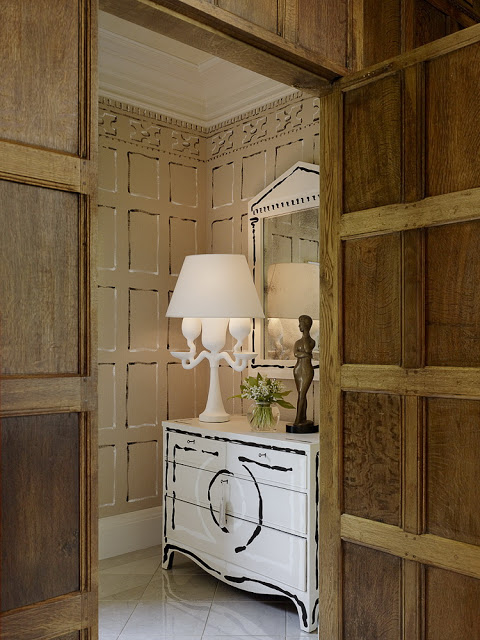
Traditional oak paneling is the jumping off point for this sophisticated powder room


"WHAT FALLS TO THE EDITING ROOM FLOOR"


ACT I, Scene I: SF Peninsula

As part of a large remodeling project, the owners of a Tudor-style home ask The Wiseman Group to create a powder room off the main entry hall. While the home is traditional, the clients are collectors of 20th c. art. They are open to the creation of something fresh and unusual. Paul Wiseman and Senior Designer Lauren Daley take on the challenge.


ACT I, Scene II: Potrero Hill Office of TWG

In order to visually tie the powder room to the adjacent hallway and echo the home's traditional oak paneling, Paul and Lauren conceive the idea of using trompe l'oeil fabric "paneling." Arriving at this concept is key to the overall story. Now that the character of the walls is developed, the rest of the plot can unfold.
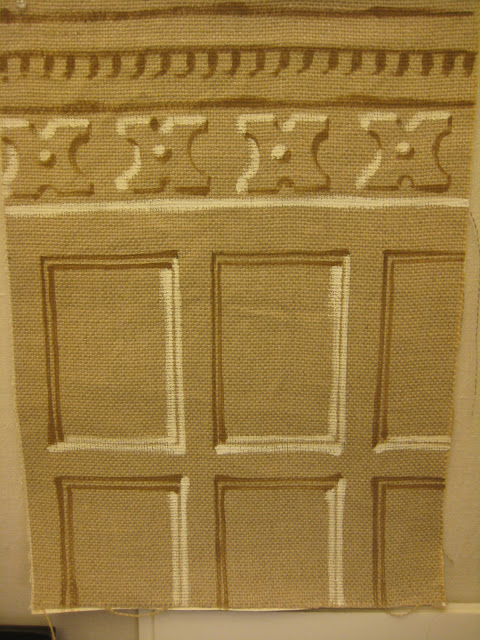
One of the many sample panels created in designing the upholstered walls


ACT I, Scene III: Lauren Daley's Office at TWG

Lauren and Paul gather inspiration from various books in the TWG library, including the work of Jean-Michel Frank, Christian Bérard, Jean Cocteau, and Alberto Giacometti. They decide on a direction and sketch their ideas. They now turn their attention to forming a team of talented artisans to execute their vision.
~
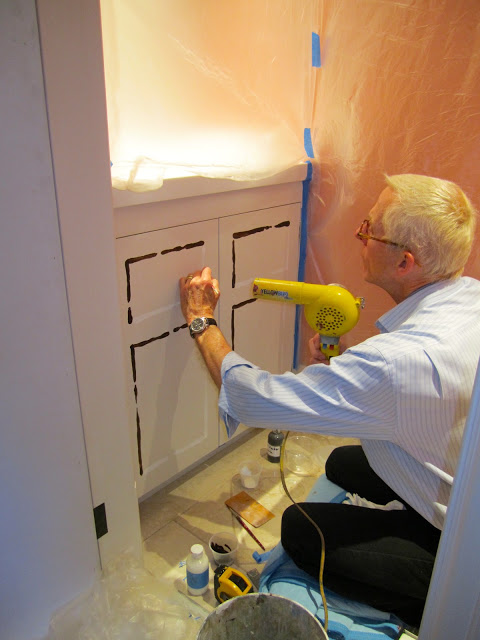
Charley Brown painting one of the powder room surfaces


ACT II, Scene I: Evans & Brown in SF

Charley Brown, one of the best decorative painters in San Francisco, is chosen to develop the pattern, line weight, and color of the trompe l'oeil fabric panels. After many rounds of gouache elevations and painted samples, the protagonists settle on a design for the walls.
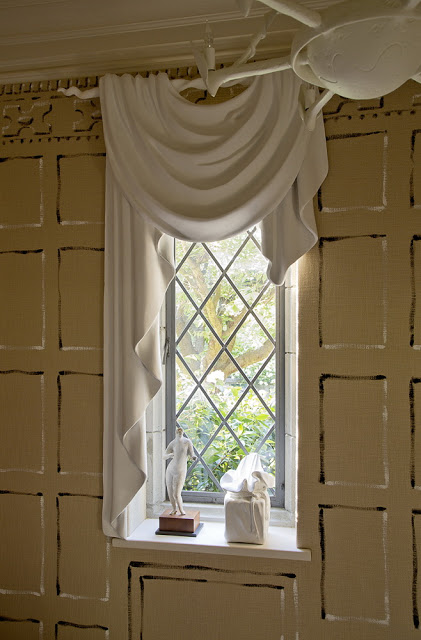

Plaster swag and "sack" tissue box made by Michael H. Casey


ACT II, Scene II: Michael H. Casey Designs in SF

Paul and Lauren enlist the help of master plaster artist Michael H. Casey to make several objets d'art for the powder room: a table lamp evocative of Giacometti, a swagged curtain for the window, and a playful tissue box in the form of a small sack tied with a rope.
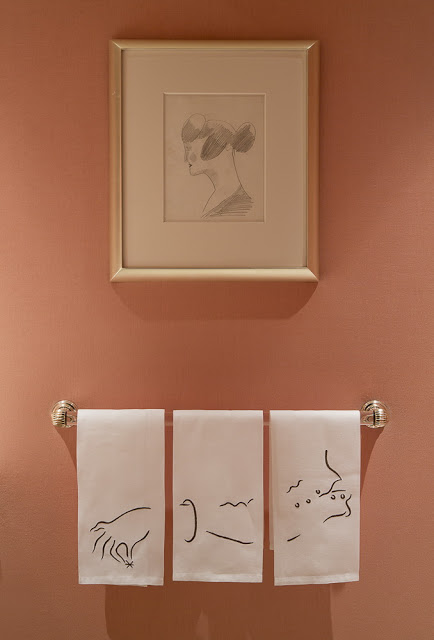

Hand towels  embroidered by E. Braun from a drawing by Charley Brown 

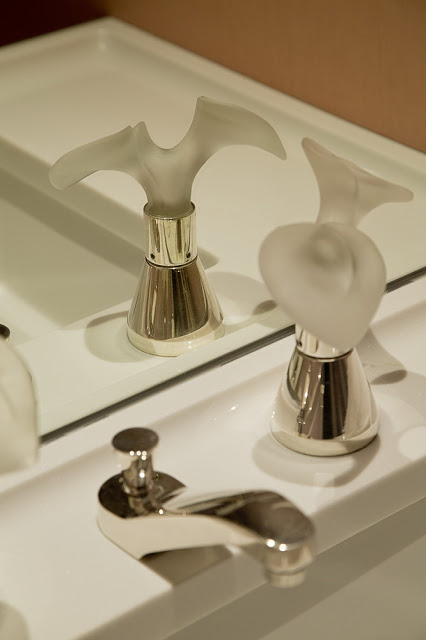
Vintage Lalique calla lily stoppers made into a unique lavatory set


ACT II, Scene III: Remaining Details Are Perfected 

A talented team is chosen to complete the job. Page & Pio Construction partners on the installation;  Charley Brown paints the fabric panels and creates a design for the hand towels, which are embroidered by E. Braun in New York; Fabric Walls installs the wall upholstery; Fox Marble in SF realizes the TWG design for a stone vanity top with raised lip; and, in a move deserving of a standing ovation, Lauren tracks down two vintage Chloe perfume stoppers (made by Lalique for use in a factice, or large display bottle) and sends them to P.E. Guerin in New York where they are beautifully transformed into a lavatory set for the powder room.

~

ACT III
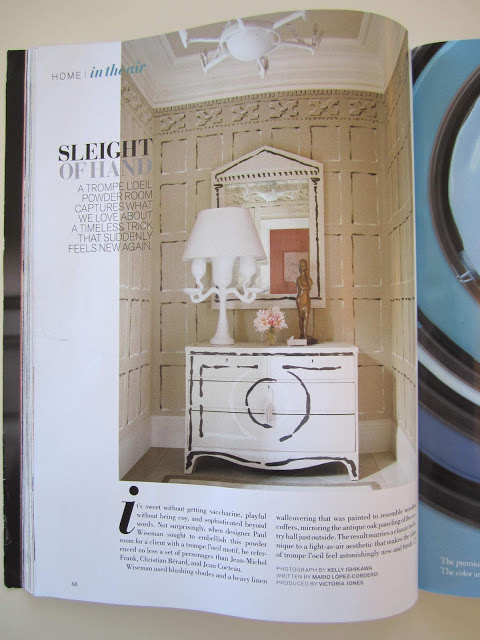

VERANDA magazine article on the powder room

VERANDA magazine lifts the curtain to give a tantalizing glimpse of the completed powder room in their April 2013 edition. The one-page article runs under the title: "Sleight of Hand: A trompe l'oeil powder room captures what we love about a timeless trick that suddenly feels new again" (page 68). Readers of TWG : Design Journal, however, are treated to front row seats for the entire performance.

~

Bravissimo!


CREDITS


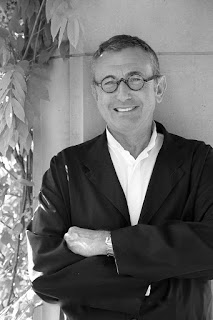
AUTHOR: Paul V. Wiseman


DIRECTOR: Lauren Daley, Senior Designer


PHOTOGRAPHER: Matthew Millman


THE NE PLUS ULTRA OF FIELD TRIPS: FORTUNY IN VENICE

Living room of Paul's Nob Hill pied-à-terre elegantly furnished with a mixture of antiques and comfortable seating
(Ottoman in "Caravaggio" in gold museum and pillows of "Carnavalet" in avocado green and silvery gold on the sofa)
Photos by Matthew Millman, unless indicated otherwise

In 1919, artist Mariano Fortuny y Madrazo opened the Fortuny factory in Venice. Originally producing fabrics for churches, museums, and the theater, Fortuny's fame grew when he began working in fashion. 

After seeing Fortuny fabrics hanging in the Carnavalet Museum in Paris in 1927,  Elsie McNeill Lee, a New York interior designer, was so enamored that she traveled to Venice to meet Mariano Fortuny. She convinced him that the fabrics were perfect to offer to interior designers and decorators. She became his exclusive distributor and, after his passing in 1949, took over the company. 

With the death of her first husband, Elsie married Italian Count Alvise Gozzi. She became known simply as "La Contessa." She hand-picked Maged Riad, her attorney, to take over the company in 1988,  and it has remained in the talented hands of the Riad family since that time.

Paul and Fortuny owner Maury Riad in Venice in 2010
Photographer unknown

For an interior designer, it is hard to imagine a greater mecca than the Fortuny factory and showroom in Venice. Paul Wiseman traveled there in 2010 for a nostalgic tour given by current owner Maury Riad. Paul first visited in 1985 when La Contessa Gozzi was still alive. After selling more Fortuny fabric that year than anyone else in the United States, he was invited to travel to Venice as her guest.

Paul booked passage on the Orient Express from Paris to Venice. On arrival, he was transported from the train station in the company's water limousine -- upholstered in what else but Fortuny! He stayed at the luxurious Hotel Gritti Palace, former residence of the Duke Andre Gritti. He was invited to tour the Fortuny showroom and garden with La Contessa. When at her home later for drinks, he was treated to a tour of her private dress collection. They then had dinner for two at Harry's Bar. Truly a memorable, once-in-a-lifetime tête-à-tête with an icon of the design world!

The ultimate luxury -- sleeping in Fortuny on Nob Hill!
(Headboard and custom  bed coverlet in "Campanelle" in Rembrandt rust, straw, and silvery gold)

Fortuny continues to represent the ultimate in luxury. The Wiseman Group recognizes the beauty and timelessness of their fabrics and is a large customer of the company. In one particularly sumptuous project, Paul created a richly subtle palette for his own Nob Hill pied-à-terre by using Fortuny fabrics throughout.

Display niche with shelves upholstered in "Caravaggio"


Cover of Fortuny Interiors, 2012
Photo by Erik Kvalsvik

To learn more about the history of this magical company and to see gorgeous interiors incorporating their lush fabrics (including Paul's Nob Hill pied-à-terre) read Fortuny Interiors, by Brian Coleman. ~

MAURICIO MUNOZ, Architectural Design Principal


Mauricio Munoz, head of The Wiseman Group’s interior architectural department, has a life story both fascinating and compelling. This calm, confident man, at the top of his professional game, offers little outward evidence of the long road that led to his living the American dream.

Born in Chile to a Spanish mother and Chilean father, Mauricio was raised with his mother’s European sensibilities, which included a deep appreciation for the cultural arts. His family’s devotion to intellectual pursuits was especially significant in light of what was happening in Chile at the time. The fascist regime of Pinochet, with its climate of fear and the pervasive threat of violence, forced Mauricio to mature quickly.

As a young man, Mauricio studied architecture in a highly innovative program at the University Catolica de Valparaiso. Guided by masters of modern Chilean architecture, his mentors helped him develop keen perceptual skills and a nonlinear, poetic understanding of how to beautify spaces. He graduated from the program with a degree in architecture and obtained a license to practice in Chile.

Mauricio, however, could not abide the chilling effects of the country’s dictatorship, and, in his late twenties, left Chile for California. While it had not been his intention to move to the Bay Area permanently, economic realities forced him to change course and stay. What followed were several years of struggle learning to speak English and establishing himself in a new country. He worked hard to make ends meet and eventually decided to return to the world of architecture. With perseverance and determination, he spent late nights mastering the techniques of computer-aided drawing and design.

A series of fortuitous events landed Mauricio a job as a temporary employee at TWG. Paul Wiseman recognized his extraordinary combination of talents and retained him as a valued member of the staff in 2001. Mauricio often manages complicated projects, both interpreting Paul’s vision and working with the client’s architect and contractors to find the most effective solution to each design challenge.

Mauricio approaches his work earnestly, aware that his clients have entrusted him to design their most important private spaces. He takes this responsibility seriously and feels there is no better confirmation of a job well done than having a satisfied client sing the firm’s praises to a friend. Such a vote of confidence is truly music to Mauricio’s ears.


Before: Three-story, San Francisco residence with a nondescript facade 

After: Increased interior space and punched up architectural interest

Before: Homey kitchen in need of an update

After: Streamlined and upgraded to a more sophisticated look

FIELD TRIP: TUCSON MINERAL SHOW


Opalized ammonite, a rare and valuable organic gemstone found primarily along the eastern slopes of the Rocky Mountains and composed primarily of aragonite, the same mineral that makes up nacreous pearls
Photos by Richard N. Snyder

The Wiseman Group is always on the lookout for unusual, one-of-a-kind objects for the home. The acclaimed Tucson Gem and Mineral Show, with its enormous selection of gems, minerals, and fossils, provides a target-rich environment.  Paul has great luck finding fascinating, richly beautiful items for clients.

Paul calls a client to tell her about one of his discoveries

Fossilized clam shells from Morocco

Intact turtle carapace fossil,  an Oligocene (34 to 26 million years old) "Stylemys" from South Dakota

Paul in front of a very large and exceptionally beautiful fossilized sea turtle formed during the Eocene period, c. 51 million years ago, in Wyoming

The show is held every year on the second full weekend of February (starting with a Thursday). It has set the standard for gem and mineral shows around the world and is now the largest show in the United States. It is open to the public and presents retail dealers only.


During the Show, Paul stays at the historic Arizona Inn. The resort hotel is spread over 14 acres of gardens with fountains, flowers and lawns in the heart of mid-town Tucson. The Arizona Inn has been family owned and operated since its creation in 1930 by Isabella Greenway, Arizona’s first Congresswoman and a lifelong friend of Eleanor Roosevelt. The Inn was added to the National Register of Historic Places in 1988.

Paul with large chunks of lapus lazuli from Afghanistan, a semi-precious stone that has been prized since antiquity for its intense blue color

All in all, The Tucson Gem and Mineral Show is a wonderful field trip. The weekend has become one of Paul's favorite ways to find unique items for discerning clients.